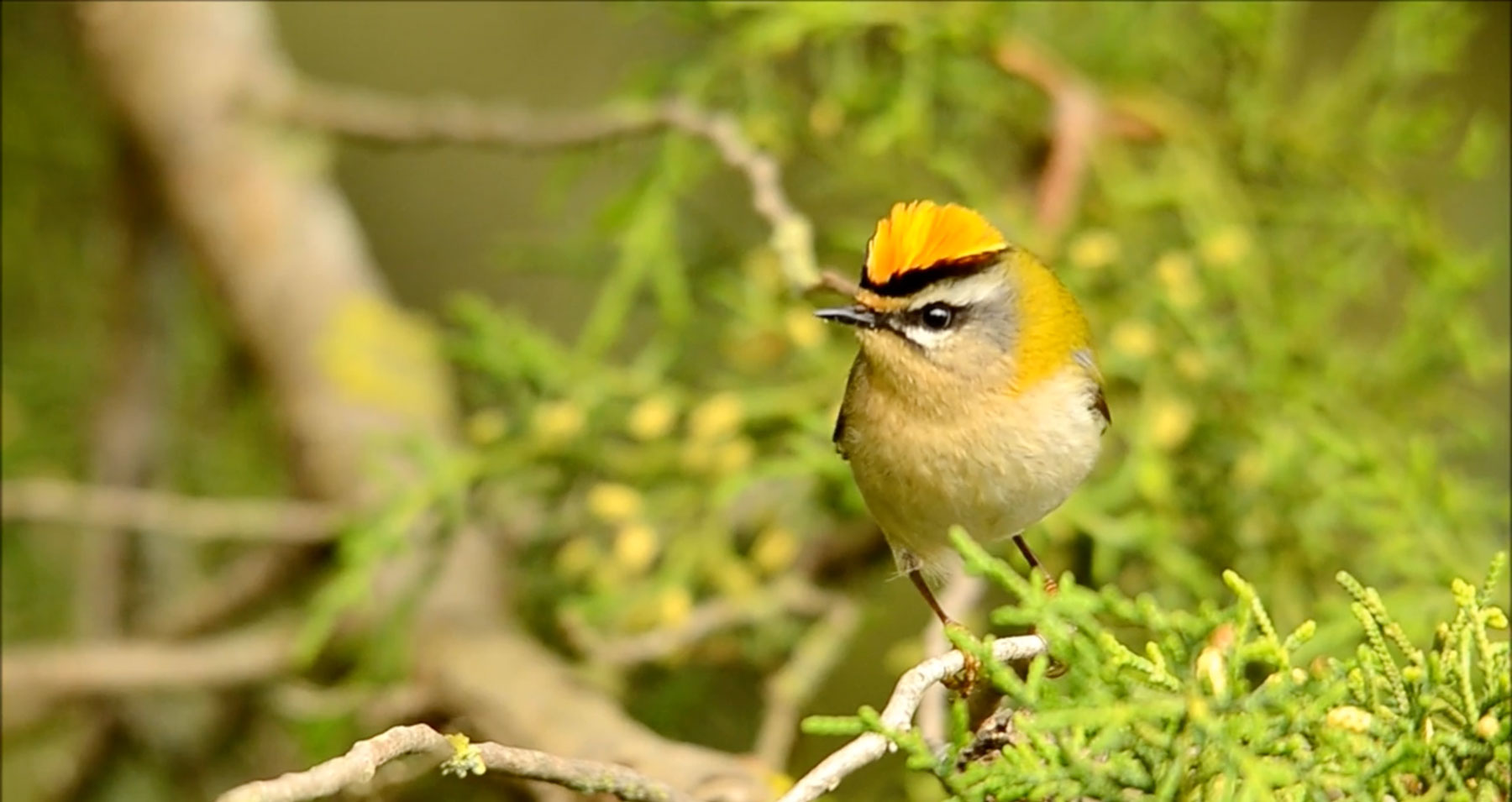
A rough guide on Firecrest from someone who hasn’t seen one yet with some biographical guff at the start

First to get warmed up: some videos from the Macaulay Library.

Introductory guff

So you want to see a Firecrest. Well of course you do.

At the time of writing Firecrest is probably the species I have the worst excuse for having not seen [Update: As of 20/11/22 this is no longer true!]. When I was just getting into birds and was visiting Lloyd Park regularly I went pretty much every day for a week or two after G Spinks found one and remember being pretty buzzed about the idea of seeing it myself. But I’ve long since had a tip-off of more than one reliable spot for them (including one place where there’s a decent number of breeding pairs) none of which I’ve bothered to visit. Thinking about it my reasons are pretty simple albeit not very defensible. First it’s one of those not-really-that-far-away-but-inexplicably-an-hour-on-public-transport jobs. Second: complacency. Being in South London I suppose I’m guessing I’ll come across one at some point and maybe it would be more fun to see one unexpectedly (whether I found it or not). Finally it’s kind of in the direction of (but not exactly close to) my ‘patch’ Beddington Farmlands and that apparently short-circuits my brain.

This all came to a head when I was back home in Boro most recently and went over (with my very obliging parents) to the Headlands to hopefully see (and hear) the Yellow-browed Warbler that had been hanging around for, I think, a few days at that point. But there was another star attraction that had drew a bit of a crowd. In fact in the time we were there (despite it having not been seen or heard at all that day) I think it’s fair to say there were consistently more people hovering around where it had been most reliably seen over the previous days than those loitering around waiting for the YBW. This other star was of course a Firecrest. I must admit that part of me thought it would have been funny to have seen one first on the North East coast when they breed maybe 15 minutes away from my flat in Croydon by car but it cemented the idea that I really had to make the effort to get out and see one.

Having been back in Croydon for a couple of weeks (and having got my hands on some new bins) I’m planning to get over to see the Firecrest with a friend as soon as we can manage. For my own amusement and edification I thought it might be fun to write a short ‘guide to Firecrests’ for my friend. For myself I’m particularly interested in separating the calls of Firecrest and Goldcrest, however I’ll try to cast a wide net. In particular I intend to cover the following in what I intend to roughly be a mish-mash of increasing difficulty and decreasing likelihood of being the thing that helps you confirm the identification.

How look?

As far as identifying a bird (not in flight) is concerned the overwhelmingly most likely species you’re going to confuse it with is Goldcrest (particularly now in Autumn when there aren’t many other small greenish birds knocking about like say Chiffchaffs). This to me feels like one of those birds where taking in the overall appearance of quite a few plumage features is probably more important than scrutinising any one thing too closely. Nonetheless you still want to know what to look for in case the views aren’t great! I’m not going to go into loads of detail with the plumage side of things since they don’t have much in common if you actually get a good look, but I’ve picked the four features that stand out the most to me:

Annotated Goldcrest (Regulus regulus), Eston Cemetery, Author.

  • The ‘Fire’ vs ‘Gold’ crest:
    As the names suggest the crests are different colours. That’s that on that.
  • The ‘supercilium’:
    The Firecrest has quite a clean white supercilium and boy is it poppin’ on that slatey grey background. The Goldcrest has got its super on back order.
  • The eyeliner:
    The Firecrest’s eye looks more closed off from the eyeliner situation its got going on. Snatched? (I honestly had no idea what that meant until I looked it up just now.) The Goldcrest has a very ‘open’ looking eye. In fact you can see that it’s got the exact opposite thing going on with the area around the eye slightly paler than the general facial zone. Needless to say you’re not going to be scrutinising these fine details but they do give a pretty strong impression at a glance.
  • The ‘shoulder’:
    Another pretty straightforward one I’d say. Firecrest has quite a saturated lemony (with a hint of orange) shoulder, whereas Goldcrest doesn’t really have a pronounced ‘shoulder’ colour at all. I suppose you’d say it can be green but then I don’t think that’s really the same feather tracts as the lemony bit on the Firecrest.

I think any one of these features seen well enough is probably going to be enough to leave you feeling pretty confident, but it’s worth saying that it can sometimes be agonisingly difficult to see, for example, the crest on a Goldcrest if the bird is a fair bit above you say. For that reason it’s handy to have an awareness of some less standout features.

Only for the, only for the, only for the hardcore oldschool ravers

(I’m not going to make much of an effort to try and order these.)

  • Belly:
    As you can see from the photos the Firecrest belly looks a lot ‘cleaner’ and closer to white. This has a lot to do with the fact that Goldcrests seem to have more diffuse boundaries between the different colours.
  • ‘Spectacles’:
    Where the Firecrest has a supercilium that goes way past the eyes as well as meeting between the eyes, the Goldcrest looks more like it’s wearing a little mask (which people often describe as ‘spectacles’).
  • Green-ness:
    Firecrests look like they have a greener back.

How sound?

Songs

Luckily Goldcrest/Firecrest are one of those species pairs where if you saw one so poorly that you couldn’t work out which you’d seen just on appearance, the songs are different enough that even if you didn’t know the songs that well there would be no doubt in your mind what you were looking at.

The Goldcrest song is very high pitched (although personally I don’t think that’s the first impression you get from it) and has a characteristic ‘cyclic’ nature. Structurally it often sounds less confident to begin with and a little more disorganised, then as the pitch (and volume) rises, after a few iterations the ‘cyclic’ nature becomes more pronounced and then the whole thing ends in a frustrated sounding yelp (you can see from the sonogram below that this little scream at the end has both higher and lower in pitch components than the ‘cyclic’ part).

By comparison the Firecrest song lacks the ‘cyclic’ structure of the Goldcrest song. The Firecrest song sounds like a ‘two-parter’: first with a fairly lazy trill between two notes fairly close in pitch (a little less than a semitone) then quickly followed by a faster (repeating itself the same number of times in about two thirds of the time) and to my ear slightly more discordant sounding trill over a wider pitch range (this time a little over 3 semitones or a minor third).

Calls

For me this is where things get tricky. In fact a large part of the reason I wrote this post is because I thought it might give me an excuse to sit down and think carefully about the comparison of the calls.

Let’s start with Goldcrest since this is probably the most familiar. At a structural level there isn’t a lot going on, and in some senses I think this is the difficulty I have with telling this and Firecrest apart. As you can hear from the clip below it can vary from one or two fairly pronounced notes, to very faint ‘chattering’ to what I think is maybe the more common or most often described call consisting of around 4 syllables (but sometimes more).

Tonally it sounds quite ‘ethereal’ and sibilant. Sort of similar in a way to that very peculiar ‘wintery’ tone that a Robin sometimes has.

What you will notice from the following clip is that the larger groupings of 4+ notes often seem to drop off in pitch slightly towards the end.

The next clip shows some deviation from the above. The tone of the stronger notes has a bit more of a buzzing quality to it and mixed in there are a couple of calls of 3 or 4 notes with only the slightest drop off in pitch.

Now onto the Firecrest.

To my ear the Firecrest notes sound a little less ‘ragged’ and have a slightly ‘purer’ tone. That being said they are still quite sibilant in quality.

[When I heard them irl I think one of the things I was most surprised by was just how different they sounded at this timbre/tonal level. I think I’d led myself to believe from listening to recordings that maybe this wasn’t that reliable.]

At a structural level there is still a lot of variation, with calls of a couple of notes, maybe a little less ‘chattering’ but probably the most common is calls of around 4 notes. It seems like often these calls of say 4 or more notes have a habit of creeping up slightly in pitch.

The next example is quite different. The calls consist of many more notes, nearer to ten. They sound slightly less slurred and there’s no real change in pitch.

In this example I think the tonal differences really show through.

The video below shows a tiny bit of ‘chattering’ with a couple of weaker notes. A more familiar call of 3 notes. And then later something a little different: a call of two notes which seem quite separated, with no slurring. Perhaps this is functionally a slightly different call?

All in all I think the reality is that the Firecrest has quite a lot of structurally different calls and I’m certainly not in a position to catalogue them. Nonetheless there are a few exhibited above which are fairly distinctive and failing familiar calls, as far as separation from Goldcrest is concerned there is helpfully a reasonable difference in the tonal qualities of their voices.

I suppose this means I need to get out and see them some more to try and understand their repertoire a bit better.

Habitat and distribution

I intend to eventually put something in about behaviour, habitat and distribution, but for now I’m just leaving this blank section in to shame myself into not forgetting about it!